Emergency Fund in Bahrain: How Much You Actually Need
Most people in Bahrain know they should have an emergency fund. Very few know how much it should be, or where the money should sit. So the fund stays a vague idea — a little in the savings account, a little in cash, nothing you could actually rely on.
This guide gives you one clear number to aim for, a simple way to reach it on a BHD salary, and the mistakes that quietly turn an emergency fund into money you cannot touch.
Start with essentials, not income
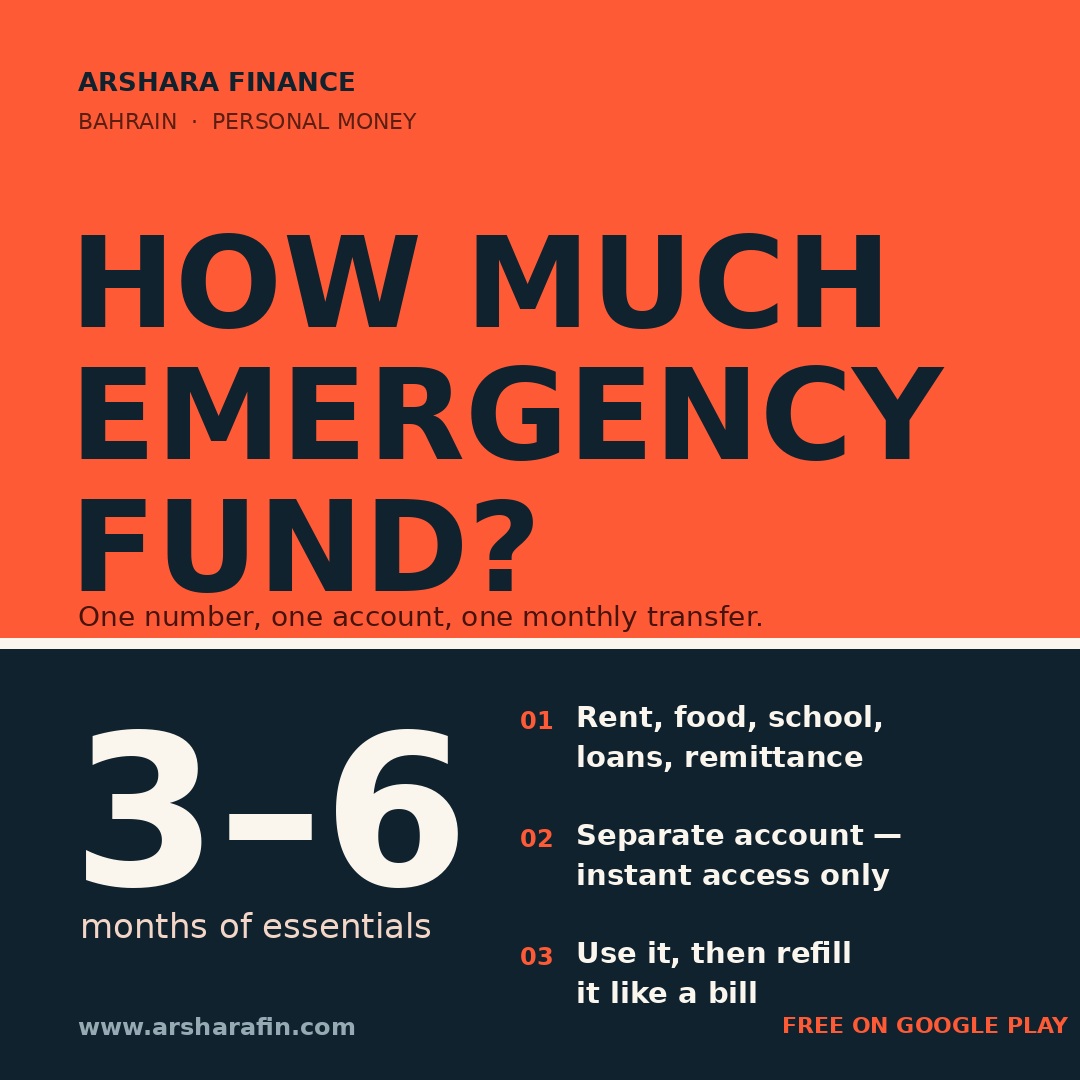
The rule that matters is three to six months of essential spending. Not three to six months of your salary. Essential spending is the money that must leave your account every month whether you like it or not:
- Rent or housing instalment
- Electricity, water, internet and phone
- Groceries and basic household supplies
- School fees, if you pay monthly
- Loan or credit card minimum payments
- Transport and fuel
- Remittance you send home every month
Dining out, travel, gifts, subscriptions and new clothes are not part of this figure. They can be switched off for a few months if they have to be. That is exactly why they do not belong in the fund.
A worked example on BD 750
Suppose you earn BD 750 a month, and your essential spending adds up like this:
- Rent: BD 220
- Utilities, internet and phone: BD 45
- Groceries: BD 120
- School fees: BD 90
- Loan payment: BD 60
- Fuel and transport: BD 35
- Remittance to family: BD 100
Total essentials: BD 670. Three months is BD 2,010. Six months is BD 4,020.
That sounds like a lot, and it is. But notice what it is not: it is not BD 4,500 (six months of salary). And you do not need the whole amount this month. You need a starting target and a monthly amount that moves you towards it.
Why three months, and when six
Three months covers the normal shocks: a job change, a medical bill, a flight home for a family emergency, or a car repair. Six months is safer if your income is variable, if you are the only earner in the household, if you are on a visa tied to your job, or if your field takes time to re-enter.
If you are self-employed or paid by commission, aim for six to nine months. In Bahrain, where residency is often linked to employment, having a buffer that also covers a ticket home and a month or two of settling is worth the extra discipline.
Where to keep the money
An emergency fund has one job: to be there the same day you need it. That rules out a few popular options.
Do not keep it in a fixed deposit. The rate looks nice, but the money is locked for a term, and an emergency does not wait for maturity. Breaking a deposit early can cost you the interest or a penalty.
Do not invest it. Shares and funds can be down exactly when you need to sell. An emergency fund is not an investment; it is insurance you own.
Do not leave it in your spending account. Money you can see is money you spend. A separate savings account at the same bank is usually the best balance: instant transfer, no card attached, and a statement you can check when you feel tempted.
Some people keep a small cash float at home, perhaps BD 100 to BD 200, for the day a card does not work. Keep the rest in the separate account.
How to build it without feeling the pain
The fund is built in the same way as any other habit: small, automatic, and before spending rather than after.
- Open the separate account this week. Name it "Emergency" if the bank allows it. A label makes the money feel different.
- Transfer on salary day, not month end. Start with an amount you will not miss — BD 50, BD 75, BD 100. Set a standing order so it leaves before you have a chance to decide.
- Add windfalls. A bonus, a tax refund, a gift, or a month where you spent less than planned — send at least half of it to the fund.
- Fill the first month, then the rest. Aim for one month of essentials first. That single month already removes most of the panic from a bad week.
- Review once a year. If your rent, school fees or family situation changes, the target changes too.
At BD 100 a month, the BD 2,010 target takes about 20 months. At BD 150 a month, it takes 14. Neither is fast, and that is normal. The point is that the number exists and the transfer happens without a decision every month.
Use it, then refill it
An emergency fund you refuse to touch is not a fund, it is a museum. If the car breaks down or a family member needs help, use the money. That is what it is for. Then treat the refill as a bill: put it back into the monthly plan until the balance is restored.
The only rule is that the fund is for events that are unexpected, necessary and urgent. A holiday is none of those. A phone upgrade is none of those. A hospital bill, a lost job or a sudden trip home is all three.
Common mistakes to avoid
- Using salary instead of essentials — this inflates the target and makes people give up.
- Keeping it in a fixed deposit — locked money is not emergency money.
- Saving whatever is left — usually nothing is left. Pay the fund first.
- Mixing it with holiday savings — one account for emergencies, another for planned spending.
- Never checking the balance — a five-minute monthly check keeps the habit alive.
Track the balance the same way you track your expenses. In Arshara Finance you can keep your emergency savings as a separate account, set a monthly transfer as a recurring transaction, and see the balance next to your other accounts on the dashboard. When the fund is visible, it stops being a vague intention and becomes a number you are building.
Start with one month of essentials. That is the whole goal for now. Everything after that is just repetition.
Track your emergency fund properly
Free · No ads · No subscriptions · Your data stays yours
Open on Google Play