Irregular Income in Bahrain: Budget When Pay Changes Monthly
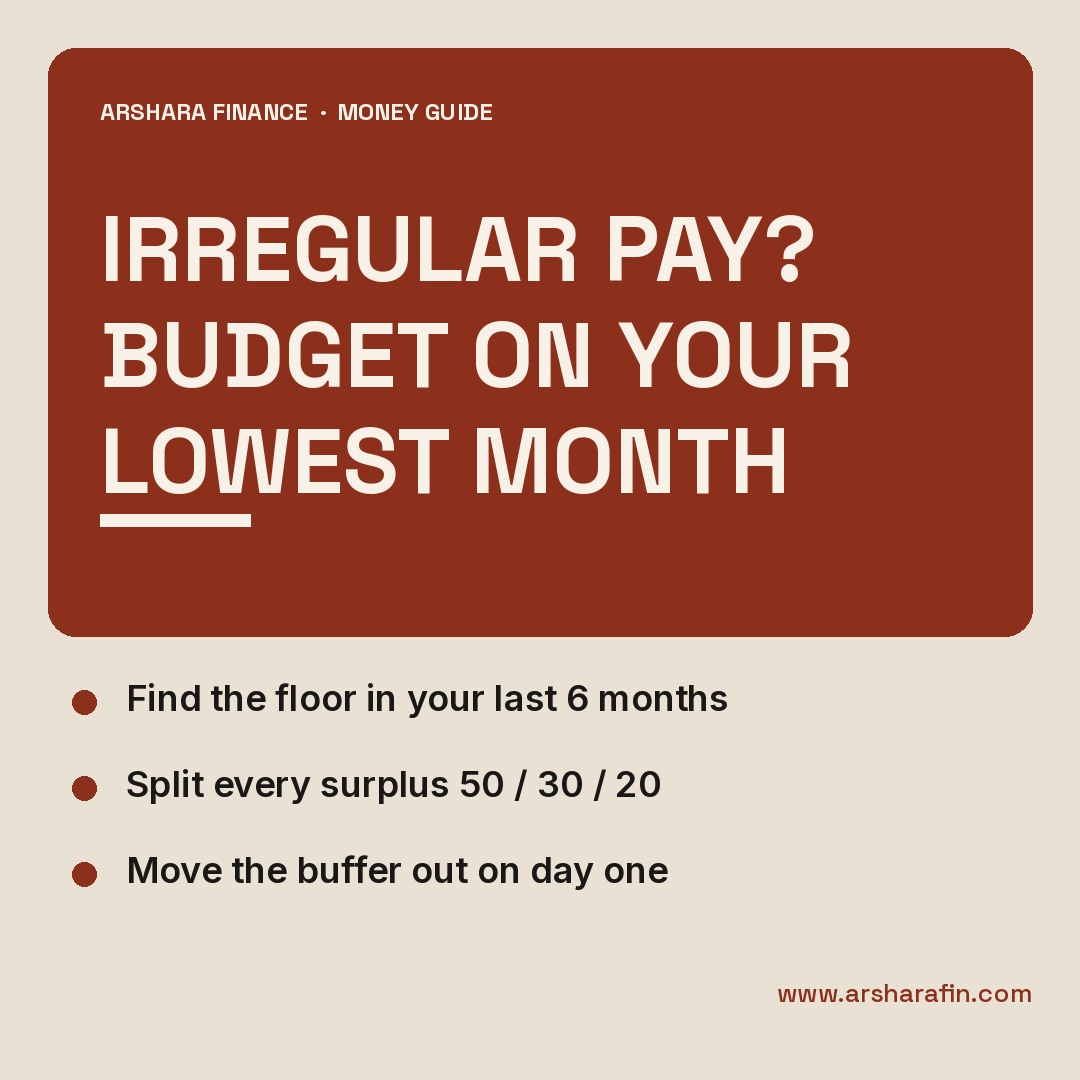
Not everyone in Bahrain is paid the same amount on the same day every month. Sales staff earn commission. Factory and site teams earn overtime. Freelancers and small business owners get paid when a client pays. Even salaried people see a month change when a bonus, an end-of-service payment or an unpaid leave day lands in it.
A normal budget assumes a fixed salary, so it breaks the first time a good month turns into a slow one. The answer is not a better forecast. It is a budget built on your worst month, with a written rule for the better ones.
Why a fixed budget fails on variable pay
Most people build the month on their best month, so one quiet month becomes a credit card balance. Or they build on the average, which overspends in half of all months by definition. Neither survives a year. What works is a floor, a buffer and a rule — three numbers, decided once, applied every month.
Step 1 — Find your floor
Write down your take-home income for the last six months. Include salary, commission, overtime, freelance payments — whatever actually reached your account. The lowest figure is your floor.
For example: BD 520, BD 610, BD 480, BD 700, BD 545, BD 660. The floor is BD 480. That is the number your household has to be able to live on, because some month will look exactly like it.
Step 2 — Build the month on the floor
Your fixed costs must fit inside the floor. Fixed means it arrives whether you like it or not: rent, EWA electricity and water, internet, phone, school fees, loan or car instalments, minimum groceries, transport to work.
A worked example on the BD 480 floor:
- Rent — BD 150.000
- Electricity and water (EWA) — BD 28.000
- Internet and phone — BD 20.000
- School fees — BD 60.000
- Car instalment — BD 85.000
- Groceries — BD 90.000
- Fuel and transport — BD 32.000
Total: BD 465.000, which leaves BD 15.000 of breathing room inside the floor. If your fixed costs do not fit, the problem is structural. Cutting groceries by BD 5.000 will not fix a BD 100.000 gap — a fixed cost has to move: the flat, the car, the school payment plan.
Step 3 — Split every surplus by rule
When a month comes in above the floor, that surplus is not spending money. Decide the split once, in advance, so a good month does not get spent by accident. A simple 50/30/20 works:
- 50% to the buffer — it pays for the months that come in below the floor.
- 30% to goals — debt clearing, emergency fund, school costs, a house deposit.
- 20% to spend now — guilt-free, because the rest is already allocated.
On a BD 610 month the surplus is BD 130.000: BD 65.000 to the buffer, BD 39.000 to goals, BD 26.000 to spend. A BD 700 month puts BD 110.000 into the buffer at once.
Step 4 — Keep the buffer out of your spending account
Income lands in account A. On the first day of the month, move exactly the floor budget to account B and spend only from B. The buffer stays in A, untouched except in a below-floor month.
Your buffer target is two months of the floor — BD 960.000 in this example. Build that before you push money into goals, because the buffer is what stops a slow month from becoming a loan. Once it is full, the 50% share moves to goals instead.
Step 5 — Add the annual bills before they surprise you
Car registration, insurance, school books, visa and CPR renewals, Eid and Ramadan spending. Add up the year, divide by twelve, and treat that number as a fixed cost inside the floor. BD 300.000 a year is BD 25.000 a month — small enough to carry, painful if it arrives in one lump.
Step 6 — Review once a month, for ten minutes
On the last day of the month, write three lines: what came in, what went to the buffer, what is left in the buffer. Nothing more. The point is not a perfect record; it is noticing the month where the surplus quietly vanished.
The traps that cost the most
- Treating a good month as a raise. Three strong months in a row is exactly when people upgrade the flat or the car. The new fixed cost is permanent; the income is not.
- Paying the buffer last. If the transfer happens after the shopping, it never happens. Move it on day one.
- Borrowing to smooth a gap while the buffer sits unused. That is the buffer's whole job — let it do it.
- Mixing currencies without converting. If part of your income arrives in another currency, convert everything to BHD at one rate before comparing months.
Where the app helps
Arshara Finance keeps the arithmetic out of your way. Enter income as it arrives and the app shows the real total, not the salary you hoped for. Set rent, school fees and instalments as recurring entries so they post themselves, and tag spending by category so the floor stays a floor. It works offline, with your data on your phone.
Budget the month you actually have
Free · No ads · No subscriptions · Your data stays on your phone
Open on Google PlayIf your pay moves around every month, the floor is the number that keeps you safe. Pick it once, move it on day one, and let the good months pay for the quiet ones.